
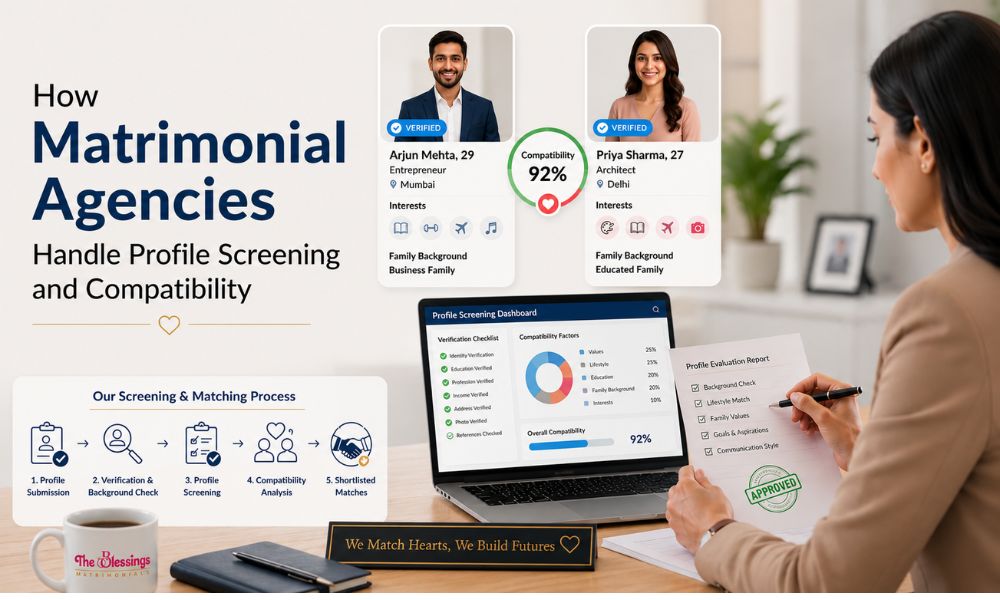
Choosing a life partner is one of the biggest and most meaningful decisions a person makes in their life. In India, where marriage is often seen as a bond between two families as much as two individuals, the search for a suitable partner is usually handled with care, patience, and seriousness. While online platforms and social apps have changed how people connect, many families still rely on matrimonial agencies for a more structured and reliable process.
One of the biggest reasons behind this trust is how matrimonial agency in delhi handle profile screening and compatibility. Unlike random online searches, these agencies follow a step-by-step system to ensure that every profile shared is genuine, relevant, and suitable.
This process makes matchmaking more organized, secure, and effective.
Why Profile Screening Is Important in Matchmaking
In today’s time, information is easily available, but not always accurate. Many people create profiles online, but not all of them are complete, truthful, or serious about marriage.
This can create confusion and waste time.
Profile screening helps remove these risks. Before suggesting a match, matrimonial agencies review important details to make sure the information provided is correct and relevant.
This gives families confidence and creates a stronger foundation for the matchmaking process.
The First Step: Understanding Personal Details
The screening process usually starts with basic personal information.
This includes:
- Full name
- Age
- Education
- Occupation
- Location
- Marital status
- Religion or community preference
At this stage, agencies gather essential information to create a clear profile.
But this is only the beginning.
The goal is not just to collect information, but to understand the individual properly.
Family Background Assessment
In arranged marriages, family background often plays a major role.
Matrimonial agencies spend time understanding family structure, values, and expectations. This can include:
- Joint or nuclear family setup
- Family profession
- Cultural traditions
- Social background
- Lifestyle preferences
This step helps identify whether two families are likely to feel comfortable with each other.
Compatibility at the family level often makes adjustment easier after marriage.
Verifying Professional and Educational Details
One of the most important parts of profile screening is verification.
Agencies often cross-check educational qualifications and professional information to ensure authenticity.
This may include confirming:
- Job position
- Industry type
- Income range
- Educational certificates
This verification helps avoid false claims and creates trust between both sides.
It also ensures that expectations are realistic.
Understanding Lifestyle Preferences
Compatibility is not just about background. Daily lifestyle matters too.
Two people may have similar education and family values but very different ways of living.
That is why matrimonial agencies ask about:
- Work-life balance
- Food habits
- Travel interests
- Social habits
- Future lifestyle goals
These details help create matches that fit naturally into each other’s lives.
Small lifestyle differences can become major issues later if ignored.
Evaluating Relationship Expectations
Every person enters marriage with certain expectations.
Some may want a partner who supports career growth, while others may prioritize family involvement or traditional values.
Matrimonial agencies often discuss:
- Career priorities after marriage
- Plans for relocation
- Interest in children
- Financial planning habits
- Personal space and independence
These conversations help understand whether two individuals are looking for the same kind of married life.
Matching Based on Emotional Compatibility
Emotional compatibility has become increasingly important in modern marriages.
A matrimonial agency pays attention to emotional factors such as:
- Communication style
- Patience and understanding
- Problem-solving attitude
- Emotional openness
- Stress handling
These qualities often shape the health of a marriage more than material factors.
When emotional compatibility is strong, relationships tend to be more stable.
Community and Cultural Matching
For many families, community and cultural alignment remain important.
Matrimonial agencies often work with specific cultural preferences and understand their importance in marriage decisions.
This may involve:
- Religious practices
- Language preferences
- Festivals and traditions
- Community customs
Such matching helps maintain cultural comfort and shared understanding.
For many families, this remains a valuable part of compatibility.
Filtering Out Mismatched Profiles Early
One major advantage of matrimonial agencies is their ability to remove unsuitable matches early.
This saves time and emotional energy.
For example, if one person wants to settle abroad and the other prefers to stay close to family, this mismatch can be identified quickly.
Without this filtering, such differences may only become clear much later.
Early screening creates efficiency.
Protecting Privacy During the Process
Privacy is another reason why many families trust matrimonial agencies.
Unlike public platforms, personal information is usually shared only with selected and relevant matches.
This keeps the process confidential and safe.
It also allows individuals to feel more comfortable while exploring potential relationships.
Guiding Families Through Decision-Making
Sometimes families find it difficult to make decisions because multiple factors are involved.
A matrimonial agency acts as a guide during this stage.
They help by:
- Clarifying doubts
- Explaining compatibility points
- Managing communication
- Organizing meetings
This support keeps the process smooth and professional.
It also reduces confusion and unnecessary pressure.
Making the Search More Focused
Without guidance, partner searching can become overwhelming. Too many options often lead to uncertainty.
Matrimonial agencies narrow the search based on clear preferences and practical compatibility.
Instead of spending months sorting through random profiles, families can move forward with better clarity.
The Human Touch Makes a Difference
Technology can help collect information, but it cannot fully understand emotions, family values, or relationship dynamics.
This is where human experience matters.
Experienced matchmakers often notice things that automated systems miss.
Their understanding helps create more realistic and suitable matches.
That human touch is what makes the process stronger.
Final Thoughts
Profile screening and compatibility assessment are at the heart of successful matchmaking. Matrimonial agencies do much more than connect profiles they build trust, create clarity, and improve the chances of finding the right partner.
By carefully understanding personal details, family values, emotional expectations, and lifestyle preferences, they make the search for marriage more structured and reliable.
In the end, a successful marriage is not built on random matches. It is built on thoughtful compatibility, trust, and shared understanding and that is exactly what professional matrimonial agencies help create.
Related: Finding Community-Based Matches Through Marriage Bureaus in Lajpat Nagar